




British weather can make choosing cycling glasses more complicated than simply selecting the darkest or most colourful lens.
A ride may begin under cloud, move into bright sunshine and then continue beneath trees, through shaded streets or across wet roads. In these conditions, photochromic and polarised cycling glasses can both improve visual comfort, but they solve different problems.
Photochromic lenses adapt to changing brightness, while polarised lenses are primarily designed to reduce reflected glare. Understanding this difference can help you choose cycling glasses that suit your actual route and riding habits.
Explore our full collection of cycling glasses and sunglasses for commuting, road cycling, mountain biking and everyday outdoor use.
In This Article
- Why Lens Choice Matters in UK Weather
- What Are Photochromic Cycling Glasses?
- What Are Polarised Cycling Glasses?
- Photochromic vs Polarised: The Main Differences
- Which Lens Is Better for UK Weather?
- When Fast-Changing Electronic Lenses Make Sense
- Which Cycling Glasses Should You Choose?
- Features to Consider Beyond the Lens
- Final Thoughts
- Frequently Asked Questions
Why Lens Choice Matters in UK Weather
The amount of light reaching your eyes can change several times during a single ride.
A cloudy morning may become much brighter later in the day. A countryside or mountain bike route may repeatedly move between open sunlight and darker woodland. During autumn and winter, low sunlight can also reflect strongly from wet roads, car windows and other smooth surfaces.
Cycling glasses also do more than manage sunlight. A wraparound sports design can help shield the eyes from wind, dust, insects and small road debris. A secure frame is also less likely to move when you look over your shoulder, ride at speed or travel across uneven surfaces.
Before choosing a lens, consider two main questions:
- Does your route involve frequent changes in brightness?
- Is strong reflected glare the main problem you experience?
What Are Photochromic Cycling Glasses?
Photochromic cycling glasses use lenses that automatically change tint according to outdoor light conditions.
The lenses usually appear clear or lightly tinted in lower light and become darker when exposed to stronger sunlight. When conditions become darker again, the lenses gradually return towards a clearer state.
For cyclists, the main advantage is convenience. One pair of glasses can cover a wider range of conditions without requiring the rider to stop and change lenses.
Photochromic cycling glasses are particularly useful for:
- Daily commuting in mixed weather
- Early-morning rides that continue into daylight
- Long-distance rides lasting several hours
- Woodland and countryside routes
- Mountain biking with alternating sun and shade
- Riders who prefer one versatile pair of glasses
However, not every photochromic lens changes at the same speed. Traditional photochromic lenses normally need some time to become darker or clearer, so riders may notice a short adjustment period when entering a tunnel or moving suddenly into dense shade.
What Are Polarised Cycling Glasses?
Polarised lenses are designed to reduce glare created when light reflects from flat, wet or shiny surfaces.
For cyclists, common sources of reflected glare include:
- Wet roads
- Car windows and bodywork
- Water and coastal routes
- Smooth paving
- Bright road markings
- Low morning or evening sunlight
Unlike photochromic lenses, most polarised lenses maintain a relatively consistent tint. Their main purpose is not to become lighter or darker, but to reduce distracting reflected light in bright conditions.
This makes polarised glasses especially useful for sunny road cycling, exposed routes, rides near water and other outdoor activities where glare is a repeated problem.
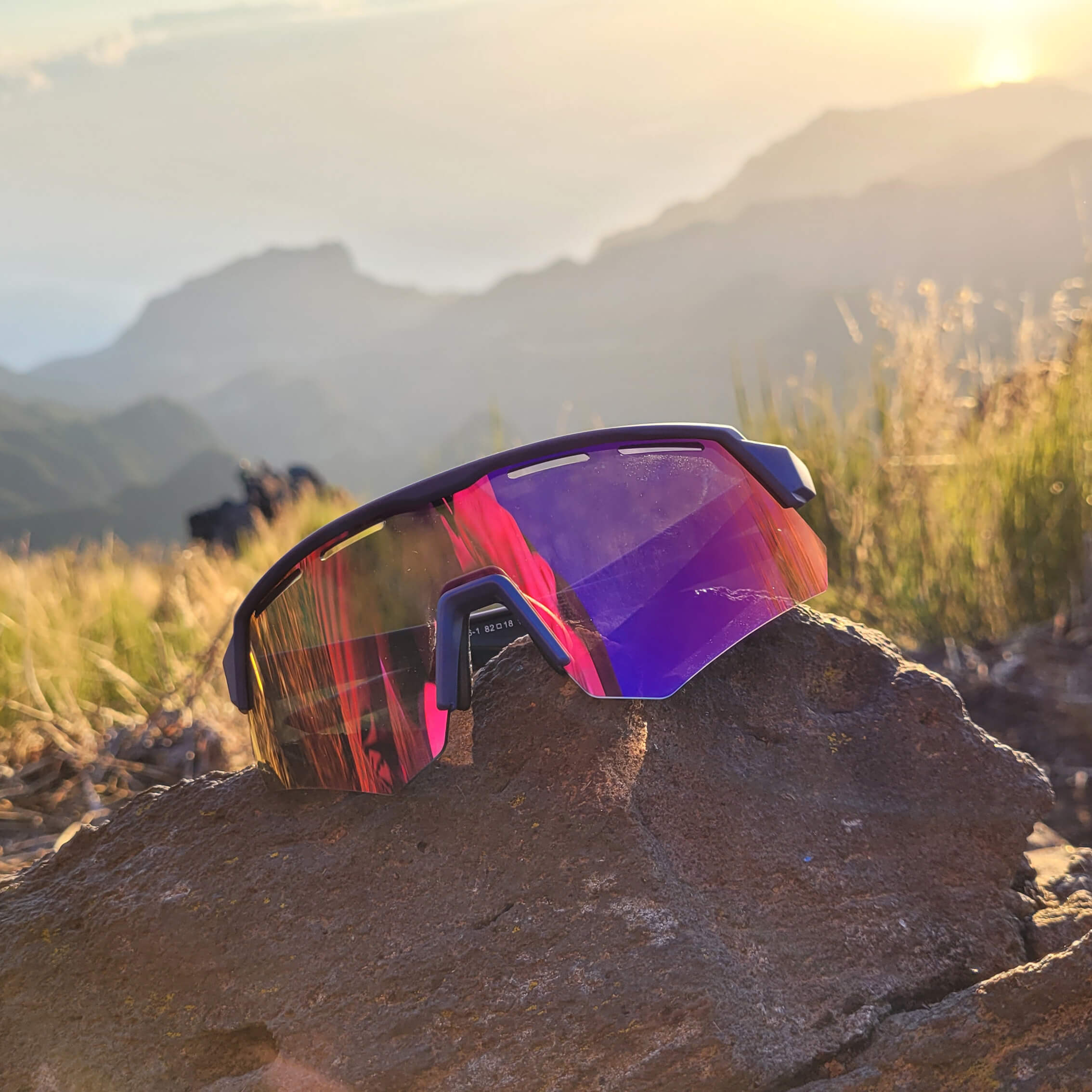
The ROCKBROS SP350 Polarised Cycling Sunglasses combine a polarised lens with UV400 protection, an anti-fog design, a lightweight TR90 frame and adjustable contact points. They can be used for cycling, driving, running and other outdoor activities.
Photochromic vs Polarised: The Main Differences
| Feature | Photochromic Lenses | Polarised Lenses |
|---|---|---|
| Main purpose | Adapt to changing brightness | Reduce reflected glare |
| Lens tint | Becomes lighter or darker | Usually remains consistent |
| Best conditions | Mixed cloud, sun and shade | Bright sunlight and reflective surfaces |
| Daily commuting | Useful for changing conditions | Useful for bright and reflective roads |
| Woodland routes | Well suited to changing shade | Dark lenses may feel less suitable in heavy shade |
| Routes near water | Suitable | Particularly useful for glare reduction |
| Night riding | Depends on how clear the lens becomes | Dark polarised lenses are generally unsuitable |
The two lens technologies are not direct replacements for each other.
Photochromic technology manages changes in overall brightness. Polarisation targets reflected light coming from roads, vehicles, water and other surfaces.
Some cycling glasses combine both functions, which can be useful for riders who experience changing brightness and reflected glare on the same route.

Which Lens Is Better for UK Weather?
For general all-weather riding in the UK, photochromic cycling glasses are often the more flexible option.
They can adapt as conditions move between cloud, sunshine and shade, making them useful for commuting, countryside routes, long-distance rides and mountain biking.
Photochromic lenses may be the better choice when:
- Your ride includes exposed roads and shaded sections
- Your morning and evening journeys have different light levels
- You regularly ride in changeable weather
- You do not want to carry several lenses
- You spend several hours outdoors
The ROCKBROS Anti-Fog Photochromic Cycling Glasses are designed as a versatile option for commuting, road cycling, mountain biking and general outdoor use.
The clear-to-grey photochromic lens adjusts to changing brightness, while the wraparound shape, anti-fog design, lightweight TR90 frame and adjustable nose pads support comfortable everyday wear. A prescription insert is also included for riders who need corrective lenses.
Polarised lenses may be the better choice when:
- You regularly ride on bright and exposed roads
- Wet-road reflections cause discomfort
- Your route runs beside water
- You also want glasses for driving, fishing or other sunny activities
- You prefer a consistent darker tint
A simple way to remember the difference is:
Choose photochromic lenses for changing light. Choose polarised lenses for strong reflected glare.
When Fast-Changing Electronic Lenses Make Sense
Traditional photochromic lenses are convenient, but the tint does not always change immediately.
This may be noticeable when moving quickly from direct sunshine into a tunnel, deep woodland, a shaded urban area or another darker environment.
The ROCKBROS Intelligent Photochromic and Polarised Cycling Glasses use an electronic light-sensing system designed to change tint in around one second.
They combine rapidly adjusting tint with TAC polarised lenses, UV400 protection, a lightweight TR90 frame and adjustable soft nose pads.
Fast-changing electronic lenses may suit:
- Road cyclists passing through tunnels and shaded sections
- Mountain bikers moving rapidly between open trails and woodland
- Long-distance riders travelling through varied environments
- Riders who want photochromic and polarised functions together
- Cyclists who are sensitive to sudden changes in brightness
For a straightforward daily commute, conventional photochromic cycling glasses may still provide all the flexibility you need. Electronic lenses are most relevant when faster adjustment is a priority.

Which Cycling Glasses Should You Choose?
For Everyday Commuting
Choose photochromic cycling glasses when your commute takes place in mixed weather or at different times of day.
A clear-to-grey lens can remain comfortable during cloudy mornings and become darker if conditions brighten later.
Students and families preparing for regular school journeys can also read our guide to Back-to-School Cycling Essentials for Students and Families.
For Sunny Road Cycling
Choose polarised lenses when you spend most of your ride on bright and exposed roads.
Reducing reflected glare can improve visual comfort during longer rides, particularly when roads remain wet after rain.
For Mountain Biking and Woodland Routes
Choose photochromic lenses for routes that repeatedly move between open sunlight and woodland shade.
A fixed dark lens may feel comfortable in an exposed area but too dark beneath trees. A photochromic lens offers greater flexibility without requiring a mid-ride lens change.
For Long-Distance and Touring
Choose photochromic glasses when your ride will continue through several hours of changing weather.
An electronic fast-changing model may be useful when the route includes tunnels or sudden changes in shade. A conventional photochromic model may be sufficient for more gradual changes between cloud and sunshine.
For Bright Multi-Sport Use
Choose polarised glasses when you want one pair for cycling, running, driving, fishing and other outdoor activities in bright conditions.
Can Cycling Glasses Be Both Photochromic and Polarised?
Yes. Photochromic and polarised technologies can be combined in one pair of cycling glasses.
The two functions remain different:
- Photochromic technology changes the tint according to light conditions
- Polarisation helps reduce glare reflected from roads, water and vehicles
The ROCKBROS intelligent cycling glasses combine both functions, making them suitable for riders who regularly experience changing brightness and strong reflected glare.
However, combined technology is not necessary for every cyclist. Consider whether both problems occur regularly on your route before choosing a more advanced model.
What About Clear and Interchangeable Lenses?
Photochromic and polarised lenses are not the only options available.
Clear lenses can be useful for lower-light and evening rides because they help protect the eyes from wind, insects and debris without deliberately darkening the rider’s view.
Interchangeable-lens cycling glasses allow the rider to select a suitable lens before leaving home:
- Dark or mirrored lenses for bright sunshine
- Yellow or amber lenses for lower light
- Clear lenses for evening and night riding
- Polarised lenses for reflected glare
Interchangeable lenses offer flexibility, but the rider needs to check the conditions and choose the correct lens before the journey. Photochromic glasses make this process more automatic.
Features to Consider Beyond the Lens
Fit and Stability
Cycling glasses should remain stable when you turn your head, ride over uneven surfaces or begin to perspire. Adjustable nose pads and rubberised temple areas can improve grip and reduce unwanted movement.
Helmet Compatibility
Check that the arms of the glasses sit comfortably with your helmet straps and retention system. The frame should not be pushed painfully against the side of your head.
Wraparound Coverage
A wider wraparound lens can provide better protection from wind, insects and small debris. It may also reduce unwanted light entering from the sides.
Anti-Fog Performance
Ventilation and anti-fog treatments are useful during cool weather, slower climbs and rides with frequent stops. No lens is completely immune to fogging, but good airflow can improve everyday comfort.
UV Protection
Polarisation, lens darkness and UV protection are separate features. Check the product specification instead of assuming that a darker lens automatically provides better UV protection.
Prescription Compatibility
Riders who require corrective lenses can look for cycling glasses with a dedicated prescription insert. The ROCKBROS multi-scene photochromic cycling glasses include an internal insert that can be fitted with prescription lenses separately.
Final Thoughts: Match the Lens to the Route
There is no single lens that is perfect for every cyclist and every weather condition.
Photochromic cycling glasses are generally the most versatile option for changing UK light, mixed-weather commuting, woodland routes and longer rides.
Polarised cycling glasses are particularly useful for bright roads, wet-road reflections, coastal routes and riders who regularly experience strong glare.
Electronic fast-changing glasses provide a more advanced solution for cyclists who move rapidly between bright and dark environments.
- Changing sun, cloud and shade: choose photochromic
- Strong glare and reflected light: choose polarised
- Rapid changes through tunnels or deep shade: consider fast-changing electronic lenses
- Regular low-light riding: consider clear or interchangeable lenses
The best pair is the one that helps you see comfortably throughout your real journey, rather than simply the pair with the darkest lens.
Browse all ROCKBROS cycling glasses and sunglasses to compare photochromic, polarised and specialist designs.
Frequently Asked Questions
Are photochromic cycling glasses good for UK weather?
Yes. Photochromic cycling glasses are particularly useful when conditions move between cloud, sunshine and shade. They can suit commuting, road cycling, mountain biking and longer rides.
Are polarised glasses good for cycling?
Polarised glasses are useful in bright conditions because they help reduce glare reflected from roads, vehicles and water. A dark fixed polarised lens may be less suitable in very low light.
Are photochromic lenses also polarised?
Not always. Photochromic and polarised are separate lens technologies. Some cycling glasses combine both functions, but many photochromic lenses are not polarised.
Which cycling glasses are better for wet roads?
Polarised glasses can be particularly useful when sunlight reflects from wet roads. Photochromic glasses may be more versatile when wet conditions are combined with changing cloud and sunshine.
Can I use photochromic cycling glasses at night?
It depends on how clear the lens becomes and the conditions in which you ride. A dedicated clear lens is normally the more straightforward choice for regular night riding.
Why do traditional photochromic lenses not change instantly?
Traditional photochromic lenses use a light-sensitive reaction that takes time to darken and return towards clear. The reaction speed varies depending on the lens technology and surrounding conditions.
How are intelligent cycling glasses different from normal photochromic glasses?
The ROCKBROS intelligent cycling glasses use an electronic system designed to adjust the lens tint in around one second. This can be useful when moving suddenly between bright and darker environments.
Do dark cycling lenses automatically provide UV protection?
No. Lens darkness, polarisation and UV protection are separate features. Always check the individual product specification.